After an upgrade, the following routine tasks are recommended:
- Run the Results Database Utility. This checks for any new or updated stored procedures and will perform any changes to the Results database. This utility does not change your data.
- Run the Site Database Utility and Datasource Database Utility. These utilities should only be run for CM4D version upgrades with a Schema change.
Additional migration tasks may be required where outlined in the release details for each version.
v25.2.25224.1 Hot Fix 2
See here for bug fixes.
ATS Licensing FIPS Support
CM4D licensing is now compliant with FIPS (Federal Information Processing Standards) regulations.
Requires ATS Licensing Server 4. If you are running the ATS Licensing WCF Host Communicator service, see here for the required configuration setting.
v25.2.24148.1 Hot Fix 1
See here for bug fixes.
This hot fix significantly effects the CM4D Results Services and may require some additional configuration for the services to start.
Results Services Settings
To support custom deployments of the Results Services, some options were added to the appsettings file. Some of these settings are specific to the type of Transport you are using with the services, e.g. Azure Storage Queues.
See the topic Configuring the Results Services for more details.
v25.2.23345.1 New Features
See here for bug fixes.
This version requires a schema update to the CM4D Site (25e) and Results databases.
CM4D Peruse Enhancements
Home Page Routine Filters
Filters are now available on the starting page of CM4D Peruse. At this time, buttons are displayed for any configured Routine filters.
See the topic Home Page to review the functionality.
Graph Annotation
Annotation templates used for the Annotation Sets introduced in the previous version have been expanded to support some graph types. Additionally, the annotation templates are now used as Reports.
See the following topics to review the functionality:
Peruse Users - Report Panel in Peruse
Peruse Admins - Peruse Report Configuration
CM4D Variable Support
The CM4D variables supported for use in CM4D Peruse annotations has been expanded to include nearly all CM4D variables, with a few exclusions.
See the topic Peruse Annotation Template Variables to see the complete list.
Subroutine Support for 3D Models
Subroutine information stored in the Results database now includes references to any 3D models associated to its parent Routine(s). Duplicate models are not generated or stored.
Updated User Interface
The appearance of CM4D Peruse has received a cosmetic update to make the interface more visually pleasing with better contrast. Two themes are available for the user to select a preference, either Light or Dark.
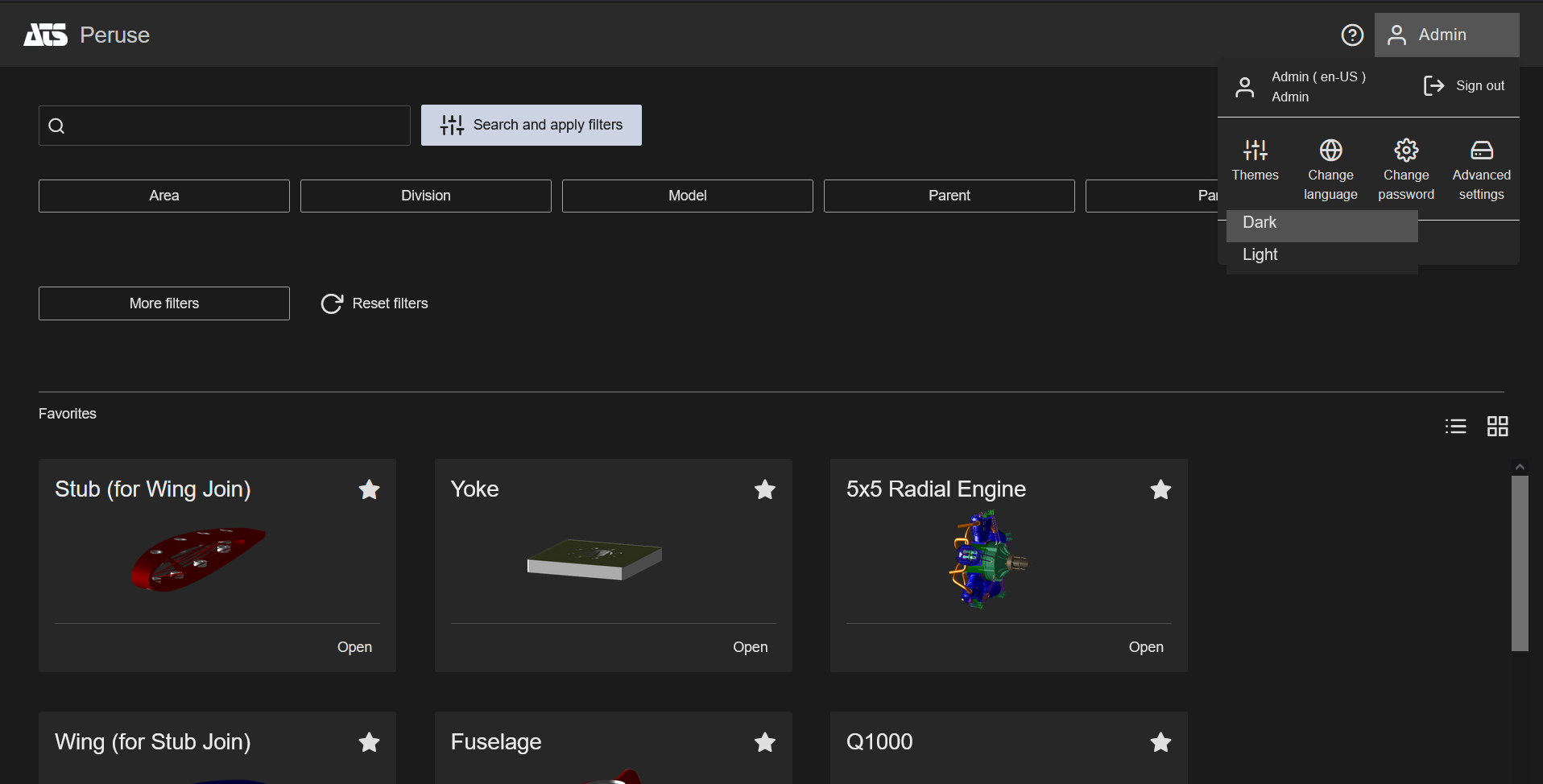
Dark Theme |
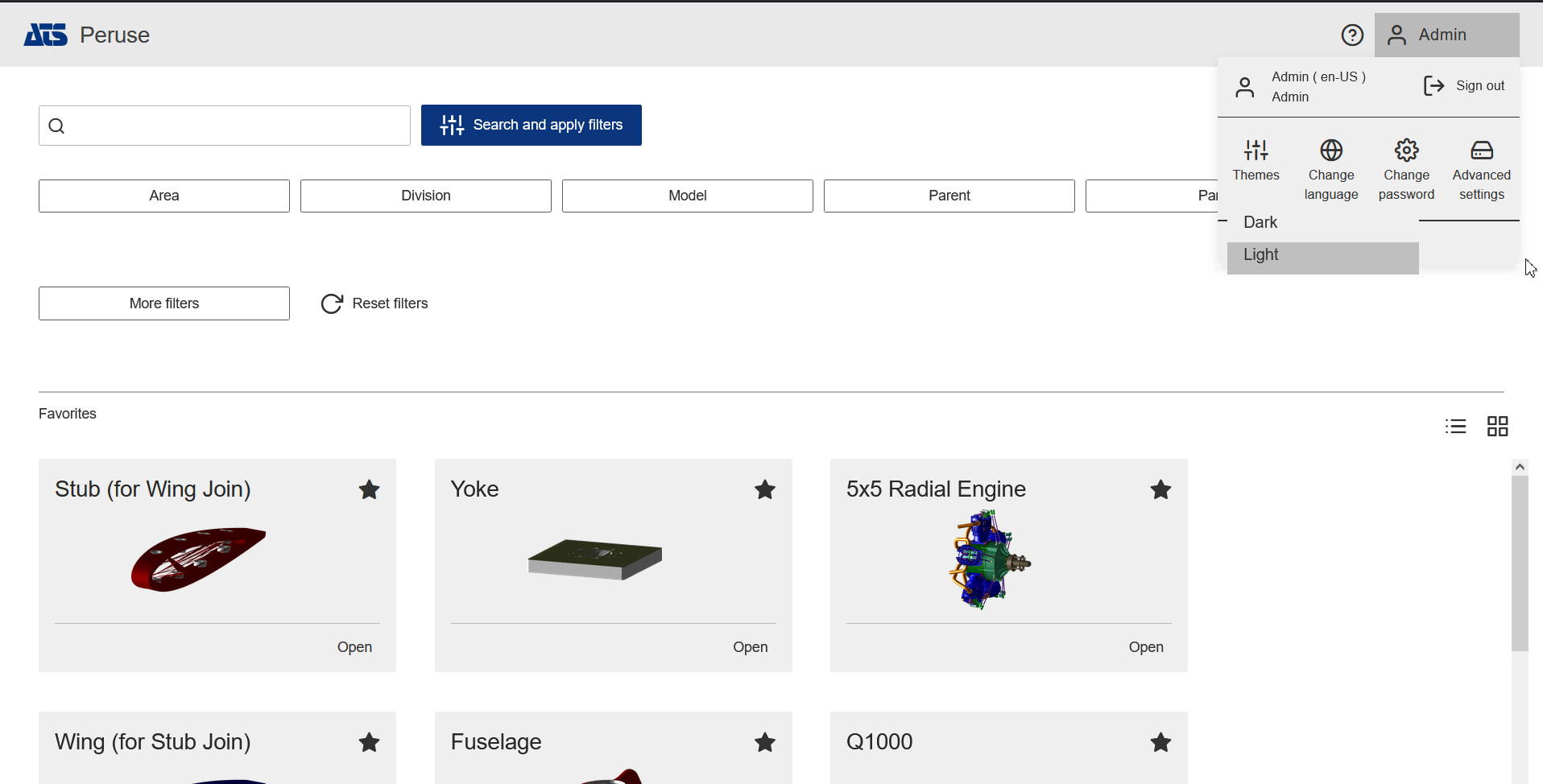
Light Theme |
See the topic Peruse User Options to review the functionality.
Spectrum Functionality Restored
Original CM4D functionality, View Spectrum, is returned using the HOOPS 3D engine upgraded in the initial release of v25. While most of the configuration options have returned as they were in v24 and earlier, the arrow type 'Label' has been deprecated.
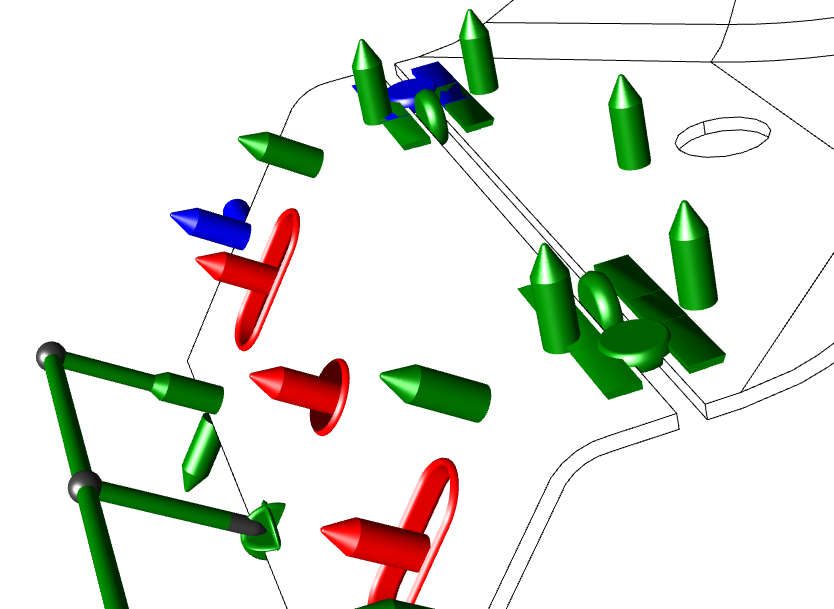
Spectrum Type: Color with multiple Feature Types (Feature Mode - Feature Specific) |
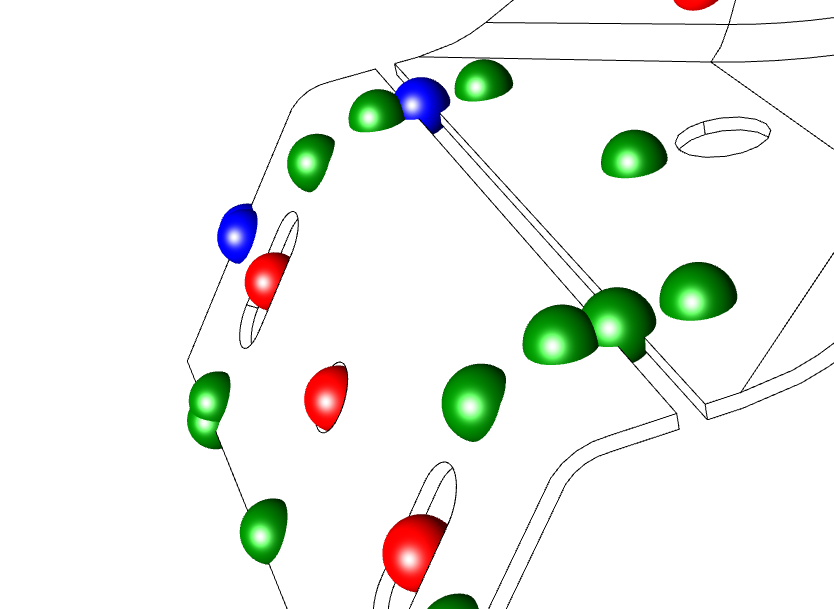
Spectrum Type: Color with multiple Feature Types (Feature Mode - Sphere) |
See the topic Spectrum to review the functionality.
Results Database - Exclude Routines by Label or Routine Filter
A configuration option has been added to CM4D Managed DataSources in the CM4D Configuration plugin which allows you to select which Routines, if any, are to be completely excluded from the data transfer. In addition to selecting Routines by label, you can use Filter arguments to designate Routines for exclusion. The filter builder is only available if the selected Managed DataSource has Routine Filters configured.
See the topic Configure Results Exclusions to review the functionality.
Results Services - Specify Managed DataSource
The Results Sender service processes the database changes in CM4D for export. Distributed installations with databases in different regions that are organized within a single Site may cause inefficiencies. For example, if a Results Sender service in Europe processes changes for a database in Asia. A configuration option is now available which allows you to restrict a Results Sender instance to process only specified Managed Datasources. It is possible to configure a datasource by DataSource label or to specify a Site and include all Datasources within that Site. The Results Sender appsettings.json file has a configuration setting "ProcessDatasources" that takes an array of definitions.
See the topic Results Services to review the functionality.
Security and Configuration Manager Enhancements for CM4D Databases
Some enhancements have been added to the CM4D Configuration plugin.
Synchronize Users, Groups and Access Privileges with Site Manager
A tab has been added to the Site Settings section of the CM4D Configuration plugin which lets you synchronize security and user information between ATS Security Manager and CM4D Site Manager. The synchronized data includes users, roles (groups) and rights (privileges).
See the topic Site Management - Site Settings to review the functionality.
Generate New or Update Databases
The three database types used by CM4D - Site, CM4D, Results - have some degree of automation available when managed via the CM4D Configuration plugin. Each of these database types have options for both creating new databases or updating existing databases to the latest schema.
Alternately, you may choose to run the update scripts manually in SSMS (legacy method) or run the corresponding Database Utility (new - see next section).
See the following topics to review the functionality:
Site Management - Managed Datasources
Site Management - Results Database
Database Utilities
Creating and updating databases for CM4D can be a lengthy process when done manually, so we have provided tools with the CM4D Server and CM4D Results Services installers to make this type of database maintenance easier. Instead of locating the scripts and running each script individually on each database (and in the right order), you can simply run each tool and select an action.
- Create or Upgrade a Site Database - Use for new installations or version upgrades.
- Create or Upgrade a CM4D Database - Use for new installations, version upgrades, or creating additional databases.
- Create or Upgrade a Results Database - Use for new installations or version upgrades.
- Replace Database GUIDs - Use after copying a database (i.e., restoring a backup).
- Generate User Roles - Use to pull user/group information from the CM4D Site database for transfer into ATS Security.
See the topic Database Utilities to review the functionality.
Docker Image Support for the following CM4D Services
The following ATS CM4D modules support Windows or Linux Docker deployments:
- CM4D Configuration Plugin and CM4D API
- CM4D Peruse
- CM4D Results Services (Results Sender, Results Loader, StreamCacheSmith)
- CM4D Upload Portal (Upload Portal, DataSmith Translator)
The available docker images can be found on the ATS Product repository on Docker Hub.
See the topic Docker Installations to review the functionality.
EventSmith SMTP V2
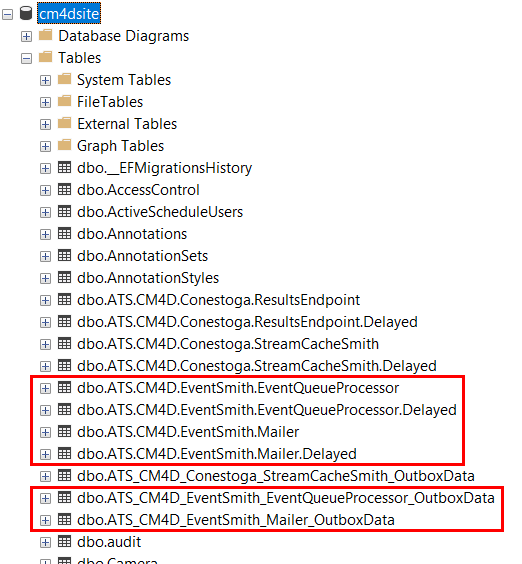
EventSmith SMTP has been upgraded to a separate installer and now supports password encryption by using NServicebus with SQL Transport infrastructure with queue tables created by the services in the Site database. The new EventSmith services (EventSmith Mailer and EventSmith Queue Processor) are a separate installer in order to allow for flexible deployments. CM4D creates event entries in the table EventQueue in the Site database, which are then picked up by the EventSmith services for processing through the Processing Queue and Mailer tables.
Upgrade Steps:
- Stop CM4D Services, particularly EventSmith SMTP and DataConnect.
- Uninstall CM4D Server.
- Install CM4D Server v25.2.
- Install EventSmith SMTP V2.
- Run Site Manager and check the SMTP Settings. If using SSL, the Authentication user name format should be the user name only (e.g., mjones), without either domain (e.g., ats-global\mjones) or email (e.g., [email protected]) formatting. This format requirement is a temporary Known Issue and will be fixed in a subsequent hot patch.
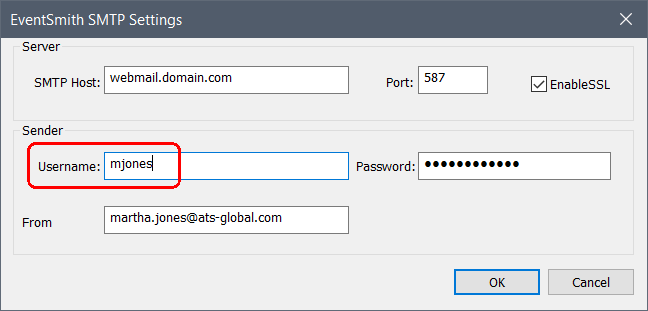
- Optionally, depending on your setup, configure the new EventSmith Services (Mailer and Queue Processor) to run as your preferred user (e.g., cm4d_service).
- Start the EventSmith Services.
- Check the CM4D Site database for 6 new tables.
See also:
Known Issues - SMTP_Mail_Server_Authentication_Username.
See here to see the release notes for previous versions.